

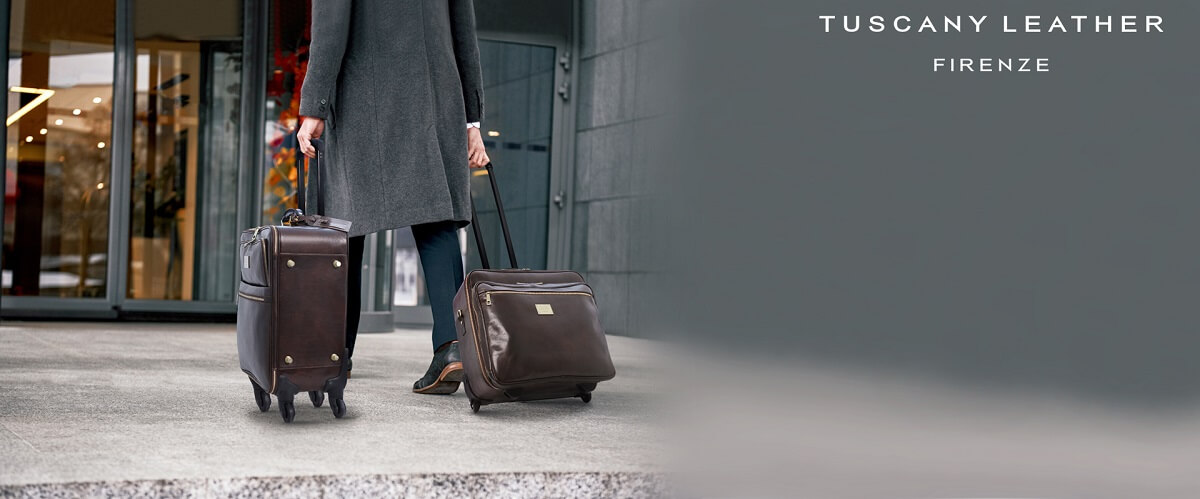
A leather trolley bag has to work during the unglamorous parts of travel: crossing a pavement, turning into a lift and being carried up steps. Before choosing the finish, examine the wheels, pulling handle, lifting points and full external dimensions. These checks help you judge the actual bag against the journeys you take.
Describe the route beyond the terminal
Think about the trip from your door to your destination. Smooth station floors, uneven streets and stairs create different demands. Note where you will roll the bag, where you must lift it and which items need to remain accessible. A wheeled bag still needs to be manageable when rolling is impossible.
If you are still deciding between a wheeled case and a soft travel bag, our leather and nylon duffle comparison offers another way to assess your travel routine before committing to a format.
Try the wheels with a representative load
The number of wheels does not tell the whole story. Ask how the model is designed to move and, where the retailer permits it, test it with an appropriate load. Try a straight line, a turn and a stop. Notice whether it pulls to one side, whether the base catches the floor and how it behaves when you change direction.
A smooth shop floor cannot reproduce every street, but it can reveal an obvious handling problem. Ask whether the wheels can be replaced, who carries out repairs and whether parts are available for that model. A specific service answer is more useful than a broad statement about lasting quality.
Separate pulling from lifting
Extend the telescopic handle through its available positions. Check that it locks and that a comfortable position lets you walk without the bag repeatedly touching your legs. If movement in the handle seems unusual, ask the retailer to explain it rather than assuming that any play is either harmless or a fault.
Now check the carry handles. Look for suitable lifting points at the top or side and enough room for your fingers. Test lifting only within the retailer’s permitted conditions and your own ability. Use the handles intended for lifting; follow the manufacturer’s instructions for the telescopic pulling handle.
Measure the entire bag
Compare external measurements that include wheels, handles and protruding pockets. Check expanded and unexpanded dimensions separately where relevant. A cabin label is not a substitute for checking the official requirements attached to your airline and ticket before each flight. Do not assume that one accepted journey guarantees acceptance on another.
Add your expected contents to the empty weight. Wheels help while the bag rolls, but the same weight still has to be lifted on stairs or into a luggage area. If you plan to carry a laptop, confirm the compartment opening, internal measurements and protection rather than relying on the overall size of the case.
Inspect organisation and care requirements
Open the compartments and see how clothes, shoes and small items can be separated without straining the zip. Check whether you can reach a document without opening the entire bag. The outer leather is only one part of the design: lining, fastenings and internal layout also affect daily use.
Read care instructions for the precise leather finish and ask about rain exposure and cleaning. Appearance alone does not establish water resistance, and wetting a bag is not a useful purchase test. Request written details of the warranty, return conditions and repair service before deciding.
Take five requirements to the retailer
Write down your maximum external dimensions, acceptable empty weight, likely surfaces, lifting needs and repair questions. When exploring designs at Tuscany Bags, ask for model-specific information against that list. The right trolley combines the leather appearance you enjoy with handling that makes sense for your route.